Taking a weekend course can make you see tongue posture, restricted movement, and mouth breathing everywhere you look. But recognizing a pattern is vastly different from truly understanding it.
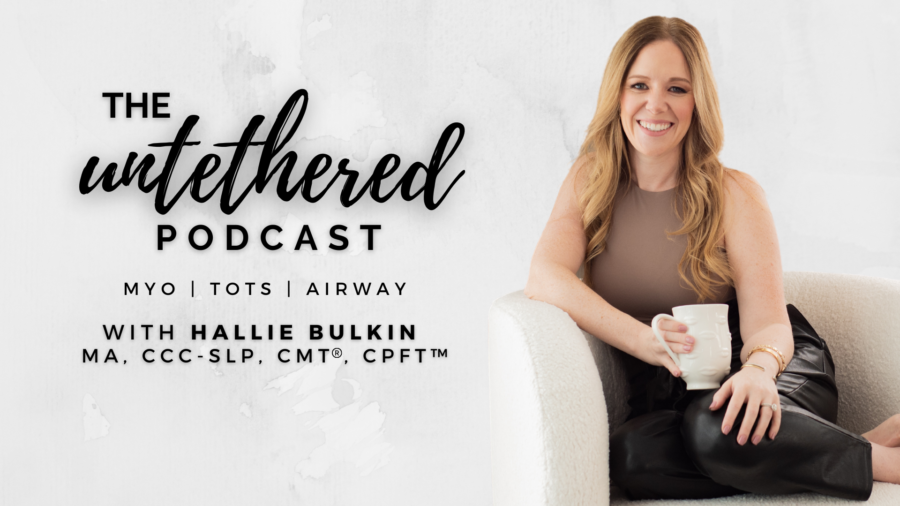
In this solo episode, Hallie Bulkin addresses “The Myo Gap” – the space between noticing an isolated anatomical finding and developing the clinical depth to understand how it fits into a child’s connected, multi-system picture. She unpacks why a restricted frenulum or forward resting tongue is merely a data point rather than an automatic diagnosis or treatment plan, and explains how shallow understanding leads clinicians to jump directly to conclusions, quick referrals, or “cookbook” exercises.
Hallie breaks down how to conduct a deeper assessment by analyzing real-time compensations, motor coordination, sensory processing, and overall physical development. You’ll learn why true clinical competence often leads to making fewer but far more valuable referrals, how to navigate honest parent conversations without false certainty, and why real clinical judgment requires mentored practice over quick information.
Key Topics & Takeaways
- The “Sensitization” Trap: How new clinical learning creates pattern-recognition bias where every finding looks like the primary root cause.
- Observation vs. Diagnosis: Why a restricted frenulum or forward tongue posture is an initial observation point, not an immediate reason to prescribe exercises or surgical releases.
- Reading the Connected System: How to evaluate tongue function relative to jaw mechanics, lip seals, nasal breathing, overall muscle tone, sensory processing, and motor coordination.
- Selective, Value-Driven Referrals: Why advanced clinical discernment leads to fewer automatic referrals for releases and results in clearer, function-based communication with ENTs, dentists, and surgeons.
- Honest Parent Conversations: The shift from presenting false certainty (“Your child has a tie, so they need a release”) to leading transparent, nuanced clinical discussions.
Soundbites
“Recognizing a pattern can feel a lot like understanding it before the depth is actually there. An observation is not a diagnosis, and it’s definitely not a treatment plan.”
“Structure matters, but function matters more. Context determines what the structure actually means.”
“Confidence isn’t giving parents a quick, simple answer—it’s being able to separate what you know from what you suspect.”
Timestamps
001:04 – The Gap Between Knowing and Understanding Myo
02:50 – Clinical Sensitization & Pattern Recognition
04:23 – Case Study: 3-Year-Old with Low Tone
06:23 – What Deeper Assessment Looks Like
07:35 – Assessing a 2-Year-Old for Feeding Concerns
09:04 – Myo Does Not Replace the Rest of the Child
10:20 – Structure vs. Function & Better Referrals 12:03 – Assessing Infants & The Feeding Dyad
13:28 – Communicating Honestly with Parents 15:20 – Myo vs. Feeding Therapy & Multi-Disciplinary Care
16:26 – How to Build True Clinical Competence
18:21 – The Myo Method & Closing Thoughts
Links & Resources
- The MYO Method: Elevate your clinical reasoning, bridge assessment gaps, and master orofacial patterns at TheMyoMethod.com.
- Fast Myo Screening Tool: Stop guessing during your intakes and download the checklist at FastMyoScreening.com.
WORTH A LISTEN: CONTINUE YOUR JOURNEY
- Episode 132: Feeding With A Twist of Myo with Hallie Bulkin, MA, CCC-SLP, COM.
- Episode 150: Where To Start And End With TOTS?.
STAY CONNECTED
💬 Join the Conversation: Catch behind-the-scenes insights, collaboration tips, and daily clinical pearls on Instagram | Facebook | LinkedIn.
If this episode challenged you to look deeper at the whole connected system on your caseload, please take a second to leave a review! Your support helps us share these critical clinical perspectives with the therapists who need them most.